
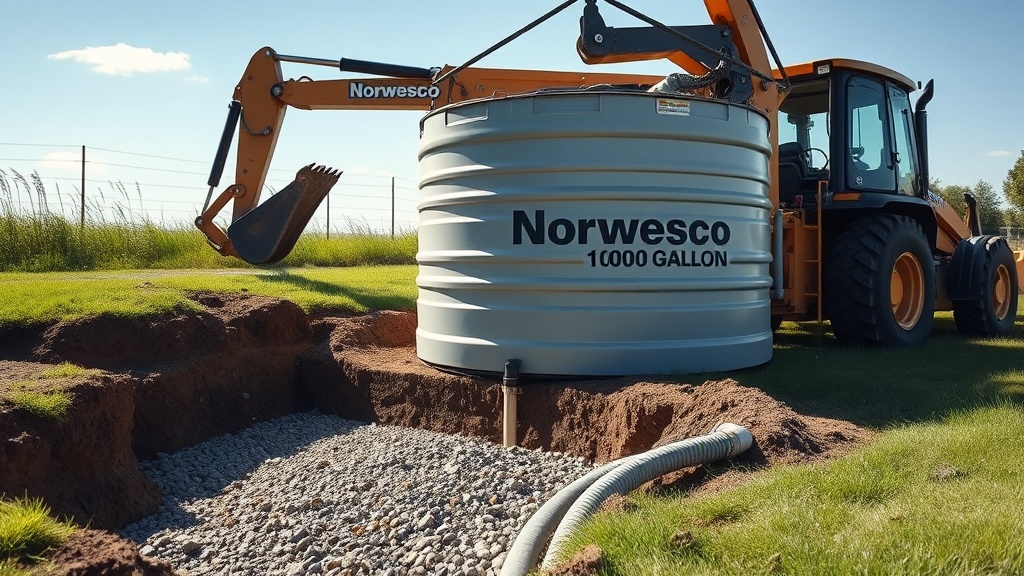
Selecting a Norwesco 1000 gallon septic tank is a solid choice for a four- to five-bedroom home, but the tank itself is only half the system. The drainfield must be correctly sized to match the tank’s daily flow capacity and your local soil conditions. Without proper sizing, you risk hydraulic overload, premature system failure, and costly repairs.
Why Does the Norwesco 1000 Gallon Tank Drainfield Need Specific Sizing?
The Norwesco 1000 gallon tank has a liquid capacity of roughly 800 gallons (accounting for sludge and scum layers). For a typical residential system, this translates to a design daily flow of 400 to 500 gallons per day (GPD) based on the standard assumption of 150 GPD per bedroom. The drainfield must be large enough to accept and treat this volume of effluent within the soil’s absorption capacity.
Soil texture—whether sandy, loamy, or clay—directly determines the required square footage of trench or bed area. A percolation test (perc test) measures the soil’s ability to absorb water, usually in minutes per inch (min/in). For example, soil with a perc rate of 30 min/in might allow a loading rate of 1.0 GPD per square foot, while a clay soil at 90 min/in might only allow 0.3 GPD per square foot. Using the Norwesco 1000 gallon tank’s design flow, the 5 Common Septic Tank Problems and How to Fix Them often trace back to undersized drainfields that cannot handle the peak hydraulic load.
Most local health departments will require a site evaluation and perc test before issuing a permit. The resulting soil loading rate dictates whether you need a conventional gravel trench system, a chamber system, or an alternative system like a mound or sand filter.
What Is the Standard Drainfield Size for a Norwesco 1000 Gallon Tank?
There is no one-size-fits-all answer, but a common starting point for a Norwesco 1000 gallon tank drainfield is 1,000 to 1,500 square feet of effective infiltration area. This assumes average soil (percolation rate of 30 to 60 min/in) and a daily flow of 400 GPD. Here is how the math works with realistic loading rates:
| Soil Percolation Rate (min/in) | Allowable Loading Rate (GPD/sq ft) | Minimum Drainfield Area for 400 GPD (sq ft) |
|---|---|---|
| Less than 10 (very sandy) | 1.5 | 267 |
| 10–30 (sandy loam) | 1.0 | 400 |
| 30–60 (loam) | 0.7 | 571 |
| 60–90 (clay loam) | 0.4 | 1,000 |
| Over 90 (clay) | 0.25 | 1,600 |
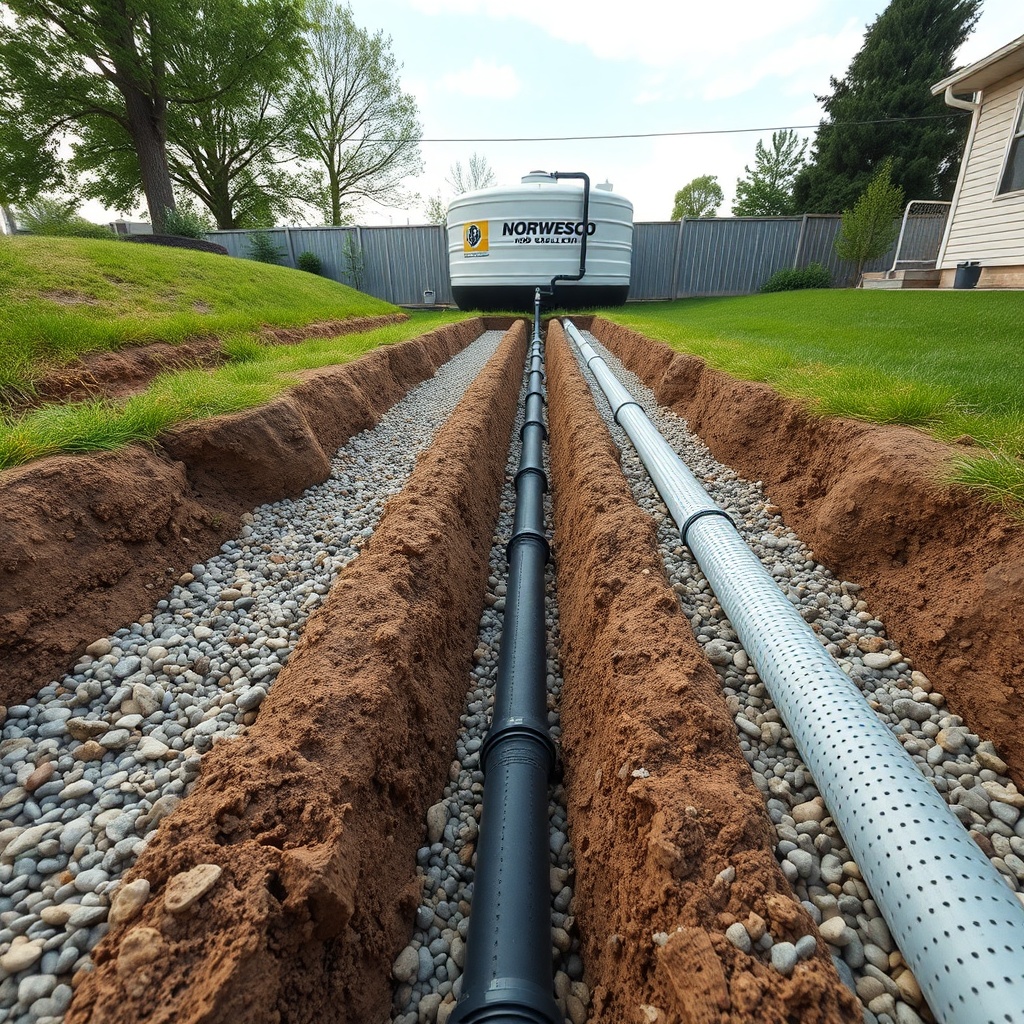
Note that these figures assume a standard trench width of 1 to 3 feet, with 3 to 6 feet of separation between trenches. Many codes also require at least 4 feet of unsaturated soil below the trench bottom. If your site has high groundwater or shallow bedrock, you may need to reduce the loading rate further or use a mound system.
Always consult your local permitting authority or a licensed designer for exact numbers. For more details on the tank itself, Norwesco 1000 Gallon Septic Tank Review: Is It Right for Your Home? covers specifications, durability, and warranty.
How Does Soil Type Affect the Norwesco 1000 Gallon Drainfield Design?
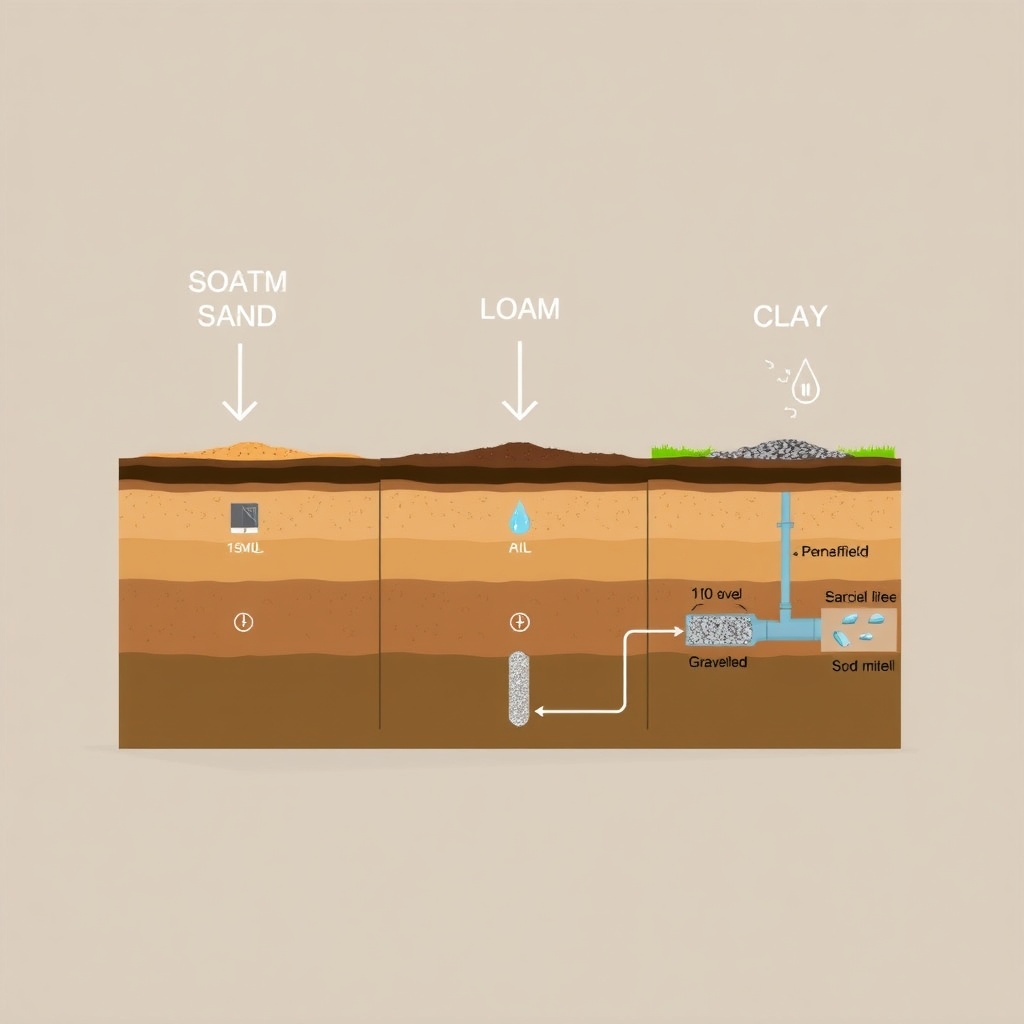
Soil type is the single most important factor in drainfield sizing. The Norwesco 1000 gallon tank can handle up to 500 GPD of organic matter, but if the soil cannot absorb that volume, the system will fail. Here is how different soils impact design:
Sandy Soils (perc rate 1–10 min/in)
These soils drain quickly but can be prone to groundwater contamination if the unsaturated zone is too shallow. You need a smaller area, but you might need to add a sand filter or increased separation distance to meet code. A typical sandy site might require 400 to 600 sq ft for the Norwesco tank effluent.
Loam Soils (perc rate 10–60 min/in)
This is the ideal range. Loam provides good filtration and adequate percolation. Drainfield size typically falls between 600 and 1,000 sq ft. Most residential lots with loam soil can accommodate a conventional gravity system with a Norwesco 1000 gallon tank.
Clay Soils (perc rate over 60 min/in)
Clay absorbs water very slowly. You will likely need a larger area (1,200 to 2,000+ sq ft) or a different system type such as a pressure-dosed bed or a mound. The Norwesco 1000 gallon tank’s 50-inch height can be a challenge for shallow burial in clay because you need proper fall to the drainfield. In these cases, a pump or effluent filter is almost mandatory.
Before purchasing, verify your soil type with a perc test or a soil profile pit. If you are also worrying about permits, Permit Requirements for Norwesco 1000 Gallon Septic Tank Installation outlines the documentation you will need.
What Are the Consequences of an Undersized Drainfield for the Norwesco 1000 Gallon Tank?
An undersized drainfield is one of the most common reasons for premature septic system replacement. For a Norwesco 1000 gallon tank, the consequences are not immediate but accumulate over 2 to 5 years. Here is a severity table outlining the issues:
| Issue | Severity Level | Signs & Typical Timeline |
|---|---|---|
| Surface ponding or soggy ground above drainfield | Critical — needs immediate attention | Sewage smell, wet spots, grass greener than surroundings; appears within 6–12 months during wet weather |
| Slow drains or gurgling plumbing | Moderate — schedule inspection soon | Drains in toilets or sinks empty slowly, especially after large water usage; develops over 1–3 years |
| Backups into house or basement | Emergency — immediate pumping and repair needed | Water or sewage rising in lowest fixtures; happens suddenly after heavy rain or high water use |
| Nitrate or bacterial contamination of well water | High — must be resolved quickly | Detected by water testing; often no visible symptom until test results arrive |
| Increased frequency of tank pumping (more than every 2 years) | Moderate — monitor closely | Sludge and scum levels rise quickly; indicates excess water or solids not being treated by soil |
If any of these appear, the drainfield may be undersized or failing. The Norwesco 1000 gallon tank itself is rarely the cause—it’s the downstream soil capacity that limits the system. Repairing an undersized field might involve adding replacement trenches or converting to a drip dispersal system. These repairs often cost between $3,000 and $10,000 depending on soil conditions.
How Does Daily Flow (GPD) from the Norwesco 1000 Gallon Tank Determine Trench Length?
Daily flow is the foundation of drainfield design. For a Norwesco 1000 gallon tank, the maximum recommended daily flow is typically 500 GPD per code. However, actual household water use may be lower or higher. Here is how trench length is calculated step by step:
- Step 1: Determine design flow. For a 4-bedroom home, assume 400 GPD (100 GPD per bedroom per many state codes, but some use 150 GPD).
- Step 2: Obtain soil loading rate from perc test. Example: 0.8 GPD per sq ft for loam with 45 min/in perc.
- Step 3: Divide flow by loading rate: 400 GPD ÷ 0.8 GPD/sq ft = 500 sq ft of trench bottom required.
- Step 4: Decide trench width. If using 2-foot-wide trenches, then total linear feet = 500 sq ft ÷ 2 ft = 250 linear feet.
- Step 5: Divide into individual trenches (e.g., 4 trenches at 62.5 ft each). Each trench must be separated by at least 6 feet for loam.
For gravel-less chamber systems, the effective width may be different, so always follow the manufacturer’s specifications. The 5 Common Septic Tank Problems and How to Fix Them article details how improper trench spacing leads to short-circuiting and system failure.
Many homeowners with a Norwesco 1000 gallon tank also install a dosing tank or pump to evenly distribute effluent across all trenches. This prevents overloading the first trench, which is a common cause of premature failure in gravity systems.
What Site-Specific Factors Can Reduce or Increase Drainfield Size for the Norwesco 1000 Gallon Tank?
Beyond soil type, several factors can force you to adjust the drainfield area. For a Norwesco 1000 gallon tank installation, these are critical to investigate:
- High seasonal water table: If groundwater rises within 4 feet of the trench bottom, your loading rate decreases. You may need to raise the drainfield (mound system) or add a pump to lift effluent to higher ground.
- Shallow bedrock: Less than 4 feet of usable soil limits infiltration. You might reduce trench width or use a low-pressure pipe system.
- Slope of lot: Steep slopes (over 15%) require careful engineering to prevent effluent surfacing. Step-down trenches or terraced fields may be needed, increasing total area by 20–30%.
- Setback distances: Minimum distances to wells, property lines, buildings, and streams can eat into usable space. A Norwesco 1000 gallon tank is 92 inches long by 67 inches wide, so plan for at least 10 feet from the tank to the drainfield.
Many homeowners discover these constraints during the permit process. If you encounter site limitations, a mound system for the Norwesco tank might require 50% more area than a conventional field. Budget an extra $2,000 to $6,000 for alternative designs.
What Owners Say
Real-world feedback from homeowners who installed a Norwesco 1000 gallon tank reveals common themes about drainfield sizing:
“I thought the 1,000-gallon tank was massive, but the drainfield was the real bottleneck. My perc test came back at 50 min/in, and the designer made me put in 240 feet of trench. I’m glad I did because three years in and no issues.” — Mark L., Virginia
“We upgraded from an old 500-gallon tank to the Norwesco 1000. The old drainfield was only 600 sq ft, but the new one is 1,100 sq ft per the health department. It was a huge dig, but the peace of mind is worth it. No more wet spots in the yard.” — Sarah T., Oregon
“My soil is heavy clay, and I nearly went with a smaller drainfield to save money. The installer warned me that the tank would fill up too fast. I ended up spending $1,200 more on extra trenches. Two years later, I’m thankful I did—neighbors with smaller fields have already had pump failures.” — David C., Tennessee
Frequently Asked Questions
1. Can I use my existing drainfield with a new Norwesco 1000 gallon tank?
It depends on the old drainfield size and condition. If it was designed for a smaller tank (e.g., 500 gallons), it is almost certainly undersized for the 1000-gallon tank’s flow capacity. A perc test and hydraulic evaluation are needed. If the drainfield is failing, it must be replaced or expanded.
2. Does the Norwesco 1000 gallon tank require a separate dosing tank for the drainfield?
Not always, but it is highly recommended for even distribution. Gravity systems can still work with proper trench layout, but adding a dosing tank and pump prevents premature failure of the first trench. Many modern codes require a distribution box or dosing siphon.
3. How deep should the drainfield trenches be for a Norwesco 1000 gallon tank?
Trench depth is typically 18 to 36 inches from the ground surface to the bottom of the gravel, depending on frost line and soil depth. The Norwesco tank’s outlet invert is usually 18 inches below the inlet, so the drainfield should be at a slightly lower elevation to maintain gravity flow.
4. What if my lot is too small for a drainfield of the required size?
You may need an alternative system like a mound, sand filter, or drip dispersal. These systems use less surface area but cost more. Check with your local health department—they might allow a reduced-size field with pretreatment (e.g., effluent filter or aerobic treatment).
5. Can I install the drainfield myself for a Norwesco 1000 gallon tank?
Some states allow DIY installation, but most require a licensed installer for the drainfield because it involves soil evaluation, deep excavation, and critical hydraulic calculations. Mistakes in trench spacing or depth can lead to system failure and permit violations.
6. How often should I inspect the drainfield after installing a Norwesco 1000 gallon tank?
At least annually, and more often if you have heavy soil or a high water table. Look for surface ponding, lush grass, or odors. Pump the tank every 3–5 years, but have a professional check the drainfield at the same time.